
Hair loss is measurable. So is whether treatment is working.
Regenerative injections for men and women with thinning or pattern hair loss, delivered as a protocol and tracked with the same photography and density counts used in clinical research.
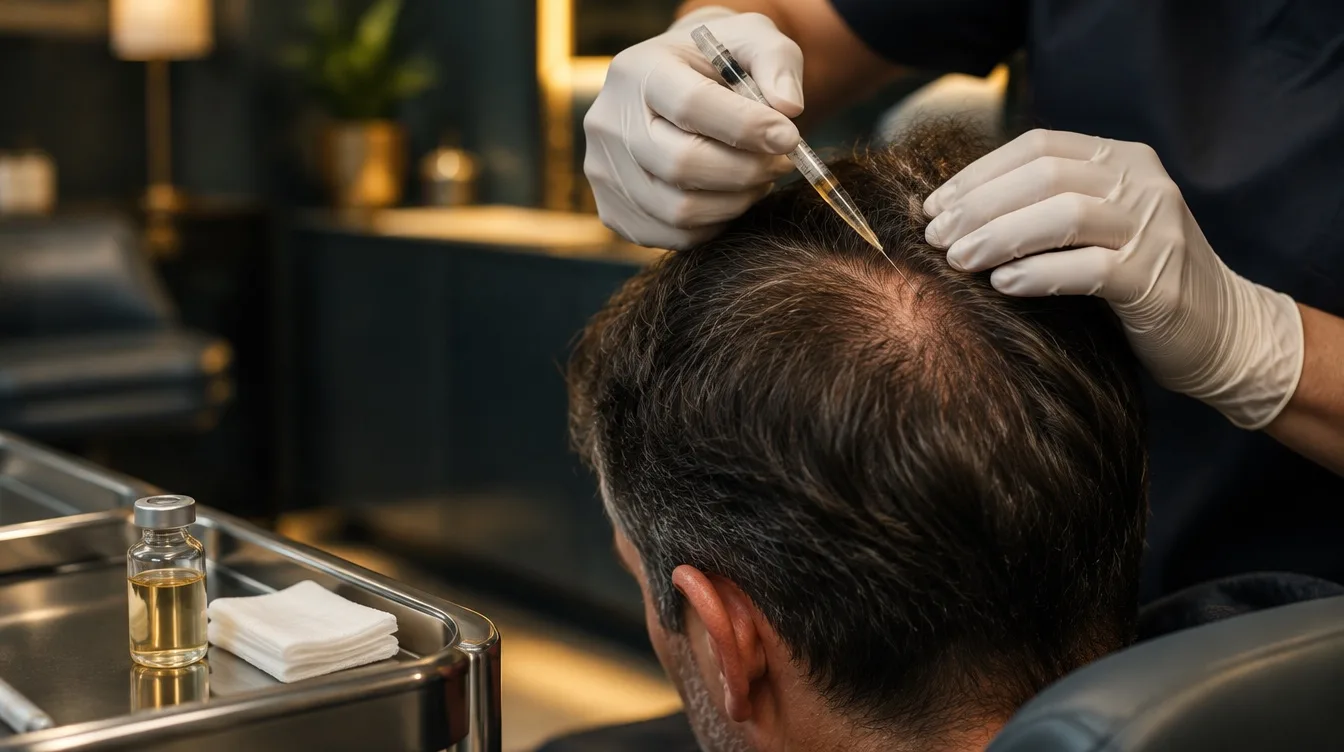
Candidacy comes first.
Hair restoration works best on follicles that are miniaturizing, not on scalp that has been smooth for a decade. At your consultation we stage your loss on the Norwood scale for men or the Ludwig scale for women, examine the scalp under magnification, and review labs that commonly drive shedding: thyroid function, ferritin, vitamin D and, where relevant, hormone levels.
That examination decides the plan. It also decides whether there is a plan at all.
Good candidates
- Visible thinning or widening part within the last five to seven years
- Early to moderate pattern loss, with miniaturized hair still present
- Non-scarring alopecia
- Post-partum, stress-related or medication-related shedding
- Patients wanting to protect a prior hair transplant
Why patients choose it
- Nonsurgical and non-invasive
- No recovery time: back to your day the same day
- No scarring, unlike a hair transplant
- Same-day treatment: we offer treatment on the day of your visit
What the first year looks like.
- Week 0 · Baseline
Consultation, scalp exam, labs, standardized photography and density count. Written protocol and schedule.
- Months 1–3 · Treatment
Injection sessions on your protocol's interval, plus at-home support: topical or oral therapy where appropriate, and nutrition targets.
- Month 6 · First follow-up
Repeat photography and counts under identical conditions. Most patients notice reduced shedding before they notice density.
- Months 9–12 · Decision
Side-by-side comparison against baseline. We decide together whether to continue, adjust the protocol, or stop.
Hair cycles slowly. Any clinic promising a visible change in six weeks is describing marketing, not biology.
Honest expectations
Regenerative hair treatments are not approved by the FDA for the treatment of hair loss, and results vary between patients. Some patients see meaningful improvement in density and coverage. Some see reduced shedding and stability, which in a progressive condition is itself a result. Some see little change, and we will tell you when the photographs say so.
We will show you the evidence as it stands, including where it is limited, and discuss alternatives, including medications with longer track records and surgical transplantation.
Questions, answered plainly.
Does it hurt?
The scalp is numbed before injection. Most patients describe pressure rather than pain, and return to normal activity the same day.
How many sessions will I need?
Your protocol is set at the consultation based on the pattern and stage of loss. Programs are structured in a series with reviews built in, rather than sold one session at a time.
Can I still use minoxidil or finasteride?
Usually yes, and often we recommend it. Combination approaches are common, and we coordinate with your prescriber.
What happens if it does not work for me?
At the review we compare standardized photographs side by side. If there is no meaningful change, we say so and discuss alternatives rather than selling another round.
Choose a time that suits you.
Pick a slot below and you will receive a confirmation right away. Prefer to talk first? Call 614-732-6509.
Start with a conversation.
Thirty minutes, no obligation, and a clear answer about whether we can help you.
Book a consultation →